

Elapidae
Tiger Snake
Notechis scutatus
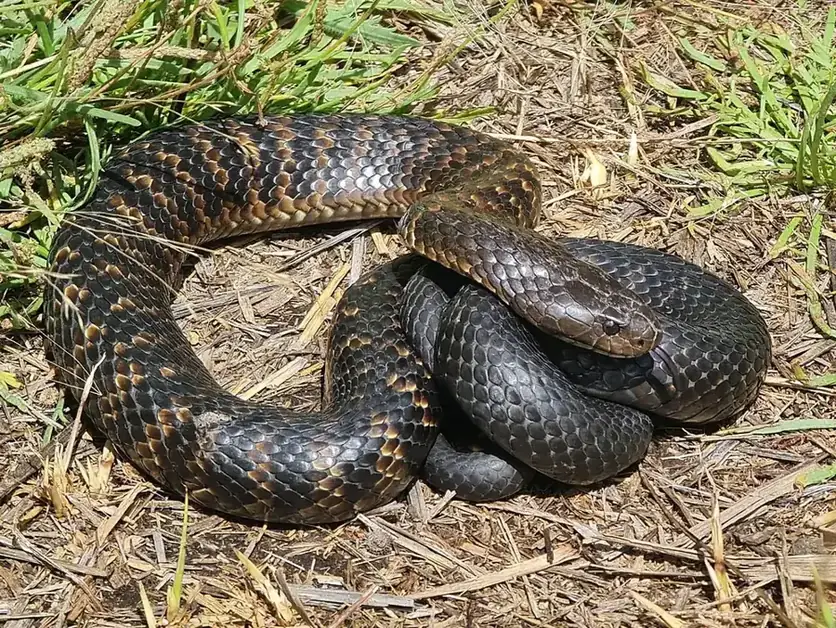
Tiger snakes may be banded, faintly marked or completely plain. They are robust snakes associated with many southern wetlands, but also occur in drier habitats. A black snake in Tasmania, or one without stripes, can still be a tiger snake.
Highly venomous
Identification and appearance
The head is broad and fairly blunt, with only a modest narrowing at the neck. Pale crossbands on a dark olive or brown body are familiar, but yellowish-brown and almost black individuals also occur. Regional differences are substantial. A snake flattening its neck is showing a defensive response, not offering a feature to test deliberately.
Other names
Eastern Tiger Snake, Black Tiger Snake
Typical length
Mainland adults average about 1.2 m. Some island populations grow larger; the Australian Museum reports a maximum of 2.4 m.
Body build
robust
Head appearance
broad, blunt, slightly distinct from neck
Key identification features
- Robust body and broad head
- Crossbands may be bold, faint or absent
- Colour and adult size vary between populations
Where it is found
South-eastern Australia, including Tasmania and Bass Strait islands, and a separate south-western Australian range. Queensland populations are localised. The ACT government explicitly records the species in the territory.
Habitat
Tiger Snakes are often associated with creeks, dams, drains, lagoons, wetlands and swamps, but also use grazing land where water and local cover remain. They shelter in fallen timber, dense matted vegetation and disused animal burrows.
Activity
Usually hunts by day, with activity extending into warm evenings. It can swim and climb, so being in water or a tree does not exclude it.
Diet
Eats frogs, reptiles, birds and mammals. Diet differs between populations, including island snakes that take nesting seabirds.
Reproduction
Gives birth to live young. Litter size varies widely with the population and female.
Medical significance
Bites can cause severe, potentially fatal envenoming affecting nerves, muscles and blood clotting.
What to do if you encounter one
Leave a clear route away from people. Do not enter reeds or lift cover to find a snake that has disappeared. If only part of the body was visible, keep the identification uncertain rather than assuming stripes were absent.
Similar-looking snakes
Copperheads can resemble patternless tiger snakes where their ranges overlap. Other dark or banded snakes also cause confusion; these comparisons are not handling tests.

Photo: Donald Hobern from Copenhagen, Denmark · CC BY 2.0 (Licence)
Elapidae
Eastern Brown Snake
Pseudonaja textilis
An Eastern Brown Snake is not always brown. Adults can be tan, orange-brown or nearly black, while young snakes may have striking dark bands. A relatively small head and slender body are more useful clues than the name alone.
Open identification guide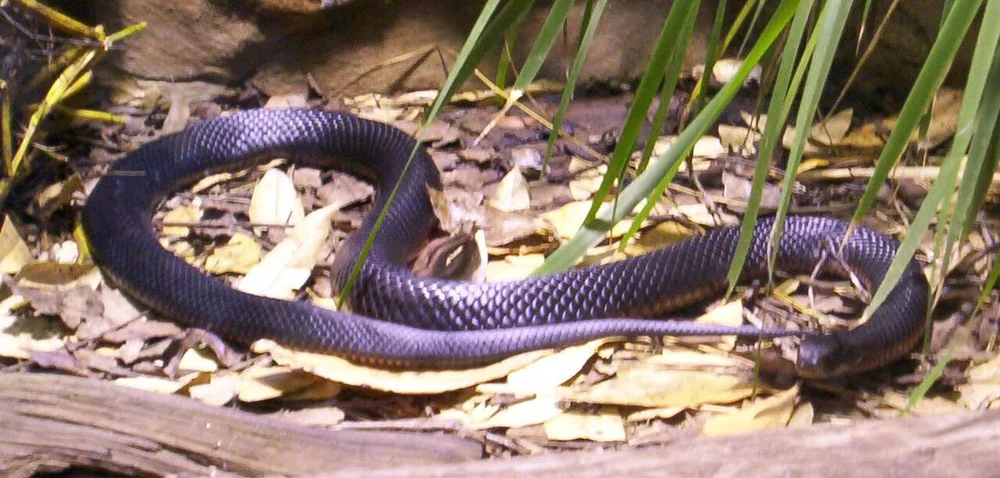
Photo: The original uploader was Figaro at English Wikipedia. · Public domain (Licence)

Elapidae
Red-bellied Black Snake
Pseudechis porphyriacus
A glossy black snake often seen around creeks, wetlands and farm dams in eastern Australia. Red or pink along the lower sides is a useful clue, but it can be hidden by the snake's position and is much paler in some northern animals.
Open identification guide
Photo: Max Tibby · CC0 1.0 (Licence)
Elapidae
Lowlands Copperhead
Austrelaps superbus
A variable venomous copperhead of lowland south-eastern Australia.
Open identification guide
Photo: Ged Tranter · CC BY 4.0 (Licence)
Elapidae
Rough-scaled Snake
Tropidechis carinatus
A dangerously venomous, strongly keeled snake of wetter habitats in eastern Australia.
Open identification guide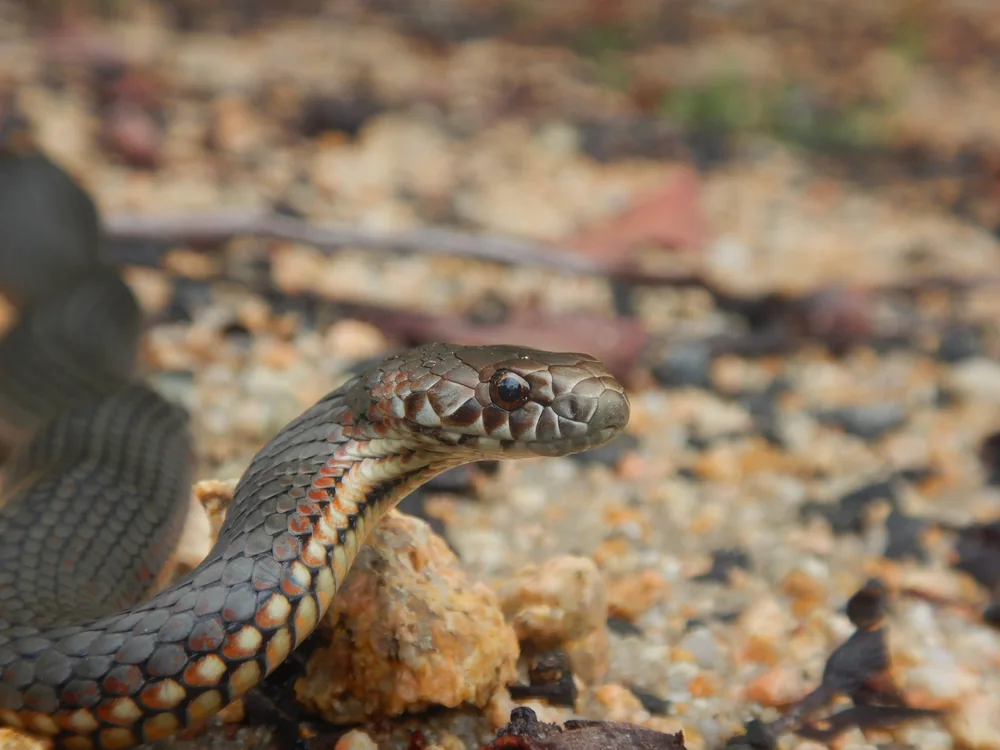
Photo: Bryce Watts-Parker · CC BY 4.0 (Licence)
Elapidae
Highlands Copperhead
Austrelaps ramsayi
A venomous snake of moist upland areas in south-eastern Australia. Its back ranges from dark grey to reddish brown, and the lips have contrasting bars.
Open identification guideTaxonomy notes
Uses Notechis scutatus for the variable Australian tiger snake, including populations historically called N. ater.
Sources checked
- Australian Museum — Tiger Snake (2026-09-25)
- Tasmania NRE — Tiger Snake (2026-09-25)
- Queensland Government — Regional snake guide (2026-09-25)
- ACT Government — Snakes (2026-09-25)
- Source for similar-species comparison (2026-09-26)
- City of Kalamunda / DBCA — Native Animals and Wildlife (2026-09-26)
- Australian Venom Research Unit — Tiger Snakes (2026-09-26)
Still not sure?
Compare this snake with more clues.
A profile is a guide, not a reason to approach or handle a snake.