
Elapidae
Highlands Copperhead
Austrelaps ramsayi
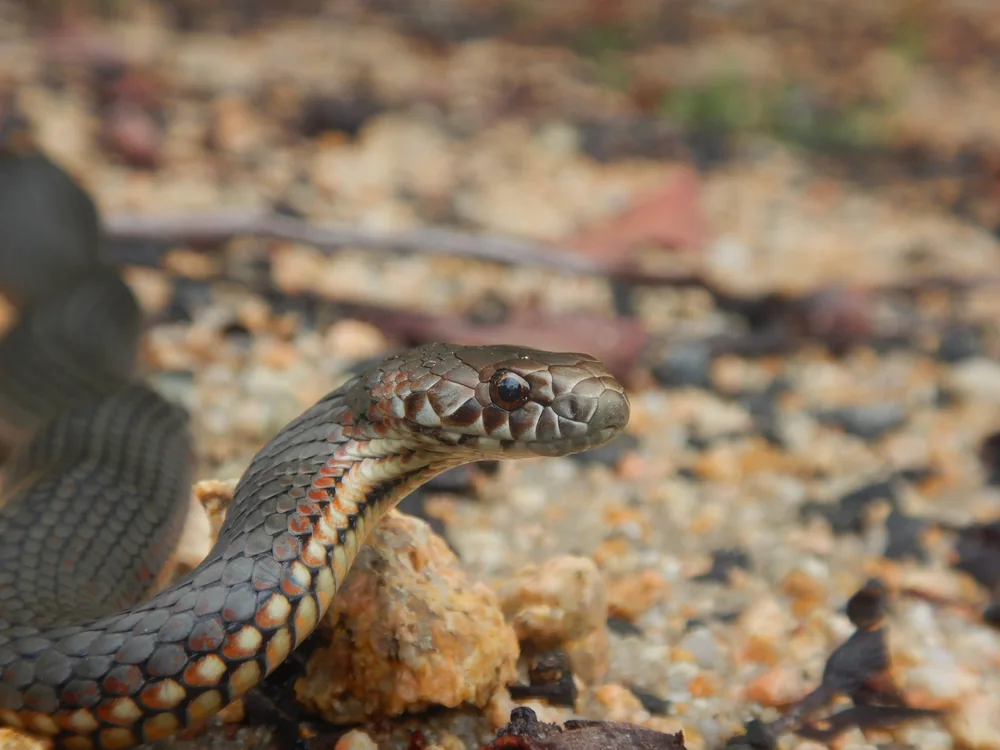
A venomous snake of moist upland areas in south-eastern Australia. Its back ranges from dark grey to reddish brown, and the lips have contrasting bars.
Dangerously venomous
Identification and appearance
AROD describes dark grey to reddish-brown upperparts, reddish flanks and heavily barred lips. The documented habitat is moist upland country such as creeks and marshes.
Typical length
AROD reports an average of about 115 cm; a maximum was not given on the consulted page.
Body build
robust
Key identification features
- Dark grey to reddish-brown body
- Reddish flanks and barred lips
- Moist upland, creek and marsh habitat
Where it is found
Highland areas of eastern Victoria and New South Wales, extending north to the New England Tableland. It also occurs in the ACT, where the ACT Government lists it among resident snakes.
Activity
Usually most active during the day.
Diet
Mostly frogs and reptiles; AROD also notes occasional invertebrates.
Reproduction
Live-bearing.
Medical significance
A suspected bite is an emergency. Call 000 and follow snakebite first aid; do not wait for symptoms or identification.
What to do if you encounter one
Keep well clear and give it a route away. If it is near a home or path, contact a qualified snake catcher.
Similar-looking snakes
Other copperheads look similar. Depending on locality, patternless tiger snakes, Eastern Brown Snakes and Red-bellied Black Snakes can also be confused with copperheads. Do not approach to compare markings.

Photo: Max Tibby · CC0 1.0 (Licence)
Elapidae
Lowlands Copperhead
Austrelaps superbus
A variable venomous copperhead of lowland south-eastern Australia.
Open identification guide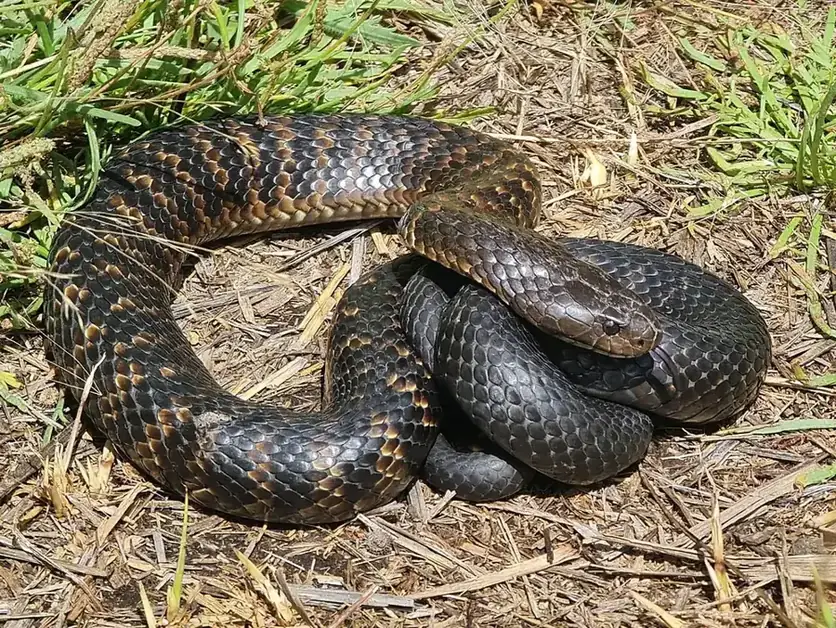
Photo: Max Tibby · CC0 (Licence)
Elapidae
Tiger Snake
Notechis scutatus
Tiger snakes may be banded, faintly marked or completely plain. They are robust snakes associated with many southern wetlands, but also occur in drier habitats. A black snake in Tasmania, or one without stripes, can still be a tiger snake.
Open identification guide
Photo: Donald Hobern from Copenhagen, Denmark · CC BY 2.0 (Licence)
Elapidae
Eastern Brown Snake
Pseudonaja textilis
An Eastern Brown Snake is not always brown. Adults can be tan, orange-brown or nearly black, while young snakes may have striking dark bands. A relatively small head and slender body are more useful clues than the name alone.
Open identification guide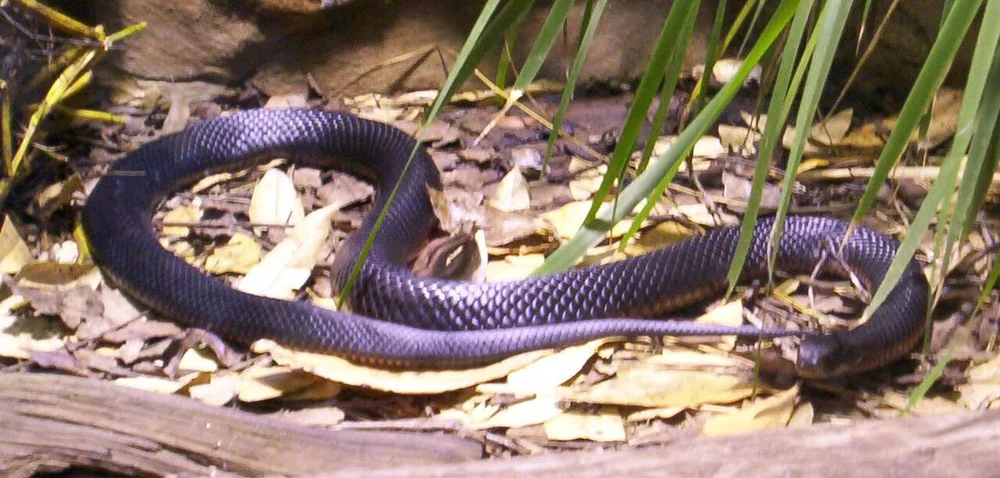
Photo: The original uploader was Figaro at English Wikipedia. · Public domain (Licence)

Elapidae
Red-bellied Black Snake
Pseudechis porphyriacus
A glossy black snake often seen around creeks, wetlands and farm dams in eastern Australia. Red or pink along the lower sides is a useful clue, but it can be hidden by the snake's position and is much paler in some northern animals.
Open identification guideTaxonomy notes
The Reptile Database lists New South Wales and Victoria, while AROD also lists the ACT; the ACT entry is retained with that source qualification. The species was formerly included within Austrelaps superbus.
Sources checked
- Australian Reptile Online Database — Highlands copperhead (2026-09-25)
- The Reptile Database — Austrelaps ramsayi (2026-09-25)
- ACT Government — Snakes (2026-09-25)
- Source for similar-species comparison (2026-09-26)
- Victorian Government Wildlife Rehabilitation Guidelines, Part B (2026-09-26)
Still not sure?
Compare this snake with more clues.
A profile is a guide, not a reason to approach or handle a snake.