
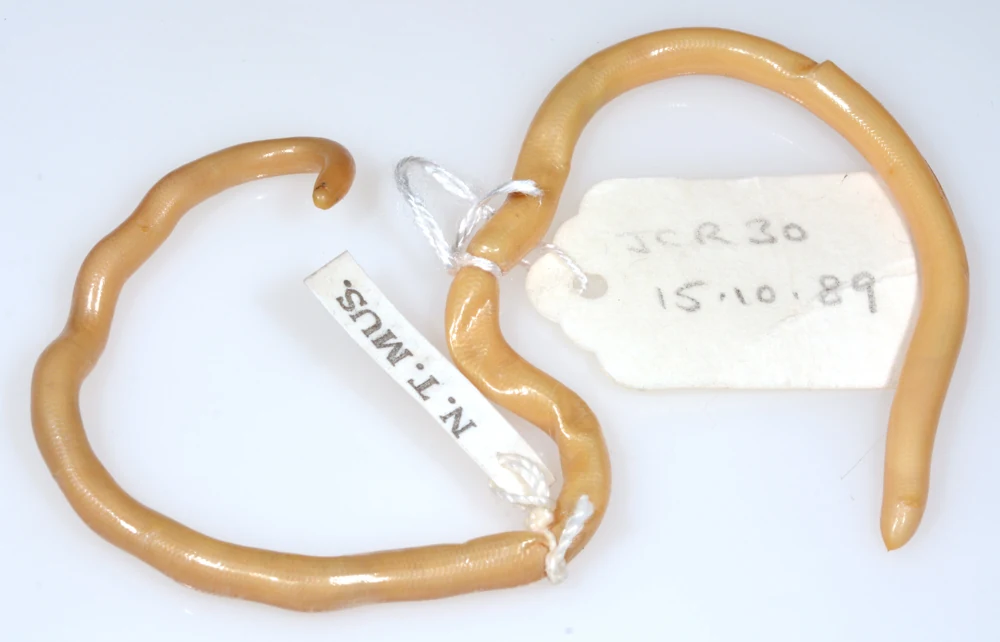
Preserved holotype of Anilios fossor, NTM R14324 (field tag JCR30). Preserved colours do not reliably represent a living snake.
Typhlopidae
Ruby Gap Blind Snake
Anilios fossor
A rarely documented blind snake known from a single Ruby Gap Nature Park specimen. Its rounded snout and terminal tail spine are technical characters for specialists, not cues to inspect a live snake.
Non-venomous
Identification and appearance
The primary diagnosis distinguishes the holotype by its rounded snout, large round rostral scale and nasal cleft contacting the second supralabial. These are specialist characters, not a reason to handle a live snake.
Typical length
The primary description records the adult female holotype at 240 mm snout–vent length plus a 5 mm tail (about 24.5 cm combined). This is a single-specimen measurement, not a population average or typical size.
Key identification features
- Snout is rounded in dorsal and lateral aspects.
- Terminal tail spine is present.
Where it is found
Known only from the Ruby Gap Nature Park type locality in the Northern Territory; the species’ full geographic extent is not known.
Reproduction
Oviparous.
Medical significance
Blind snakes are non-venomous. If the snake has not been reliably identified and a bite is suspected, call 000 and follow snakebite first aid.
What to do if you encounter one
Keep well clear and leave a route towards cover. Do not chase, corner, handle or inspect it. If it is inside a building, keep people and pets away and contact a qualified local snake remover.
Similar-looking snakes
Several blind snakes look alike. These profiles provide comparisons, but a photograph may not show the features needed to separate species.

Blackish Blind Snake (Anilios nigrescens), photographed dead on a road.
Photo: Max Tibby · CC0 (Licence)
Typhlopidae
Blackish Blind Snake
Anilios nigrescens
A glossy, worm-like burrowing snake from eastern Australia. It has a nearly uniform body thickness, tiny eyes and a very short tail. Recognising a blind snake is usually easier than telling which blind-snake species it is.
Open identification guideTyphlopidae
Centralian Blind Snake
Anilios centralis
A slender blind snake described from the Alice Springs area in Central Australia.
Open identification guideTyphlopidae
Western Kimberley Blind Snake
Anilios zonula
A small blind snake recorded from Storr and Augustus islands in Western Australia. It has a slender body, blunt snout and no tail spine.
Open identification guideTaxonomy notes
The current diagnosis says the species is known only from its holotype. The type locality supports NT, but not an exhaustive state-wide range.
Sources checked
- Australian Reptile Online Database — Ruby Gap Blind Snake (2026-09-25)
- The Reptile Database — Anilios fossor (2026-09-25)
- Shea 2015 — primary description of Anilios fossor (2026-09-25)
- Queensland Government — Blind snakes (2026-09-25)
Still not sure?
Compare this snake with more clues.
A profile is a guide, not a reason to approach or handle a snake.