

Pythonidae
Water Python
Liasis fuscus
A large non-venomous python associated with northern waterways.
Non-venomous
Identification and appearance
A dark brown to black python with an iridescent sheen and a yellow belly. The upper body is usually unpatterned. It is associated with northern waterways and wetlands.
Other names
Brown Water Python
Typical length
AROD lists an average size of about 250 cm and a reported maximum of 300 cm.
Key identification features
- Dark brown to black upperparts with an iridescent sheen
- Yellow underside
- Northern waterways and floodplains
Where it is found
Northern Australia.
Habitat
In the Cairns region, Water Pythons occur near water in eucalypt woodland.
Activity
Mainly active at night.
Diet
Reptiles (including young crocodiles), mammals, birds, bird eggs.
Reproduction
Egg-laying; AROD reports an average clutch size of 10.
Medical significance
Non-venomous, but capable of biting. If identity is uncertain and a bite is suspected, call 000 and follow snakebite first aid.
What to do if you encounter one
Keep your distance and leave the snake a clear route away. Do not handle it, chase it for a photograph or attempt to inspect its mouth. If it is inside a building, keep people and pets clear and contact a qualified local snake catcher.
Similar-looking snakes
Olive Python is a documented lookalike. Water Python usually has a conspicuous iridescent sheen; Olive Python lacks that obvious sheen.
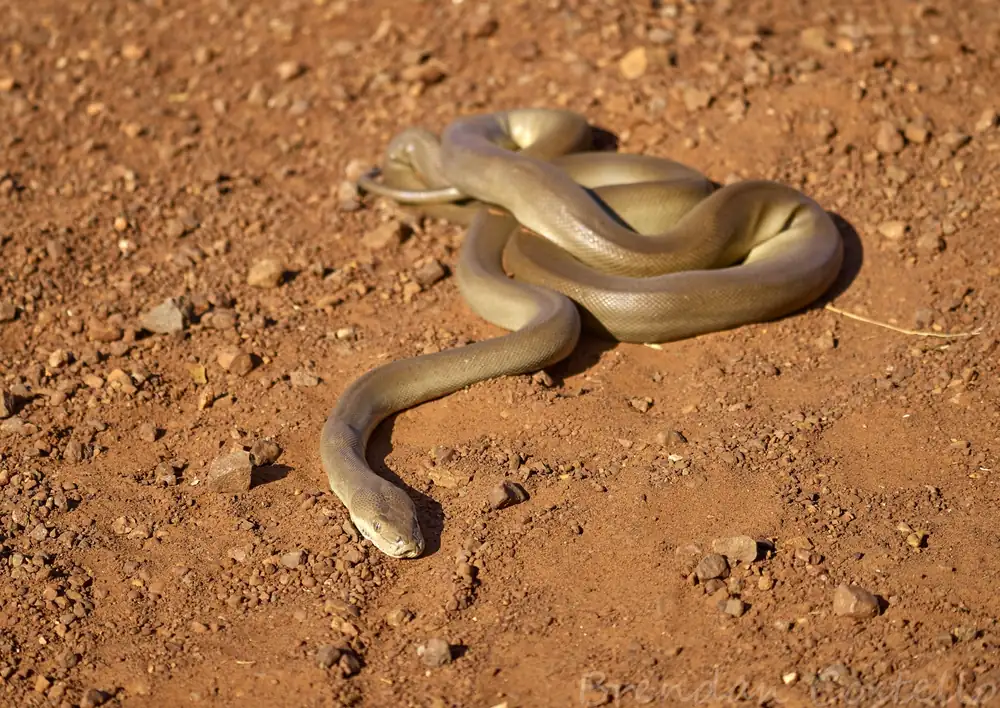
Photo: Brendan Costello · CC BY 4.0 (Licence)
Pythonidae
Olive Python
Liasis olivaceus
A very large olive python of drier northern Australia. The Pilbara subspecies occurs in Western Australia, while the species-level range also includes the Northern Territory and Queensland.
Open identification guideSources checked
- Australian Reptile Online Database — Water Python (2026-09-25)
- The Reptile Database — Liasis fuscus (2026-09-25)
- Queensland Government — Water Python (2026-09-26)
Still not sure?
Compare this snake with more clues.
A profile is a guide, not a reason to approach or handle a snake.