
A clear photograph can help identify an Australian snake, but it may only support a shortlist. Send the location with the image and keep the original file. Never move closer, handle the snake or delay emergency care to get a better photograph.
Location is part of the evidence
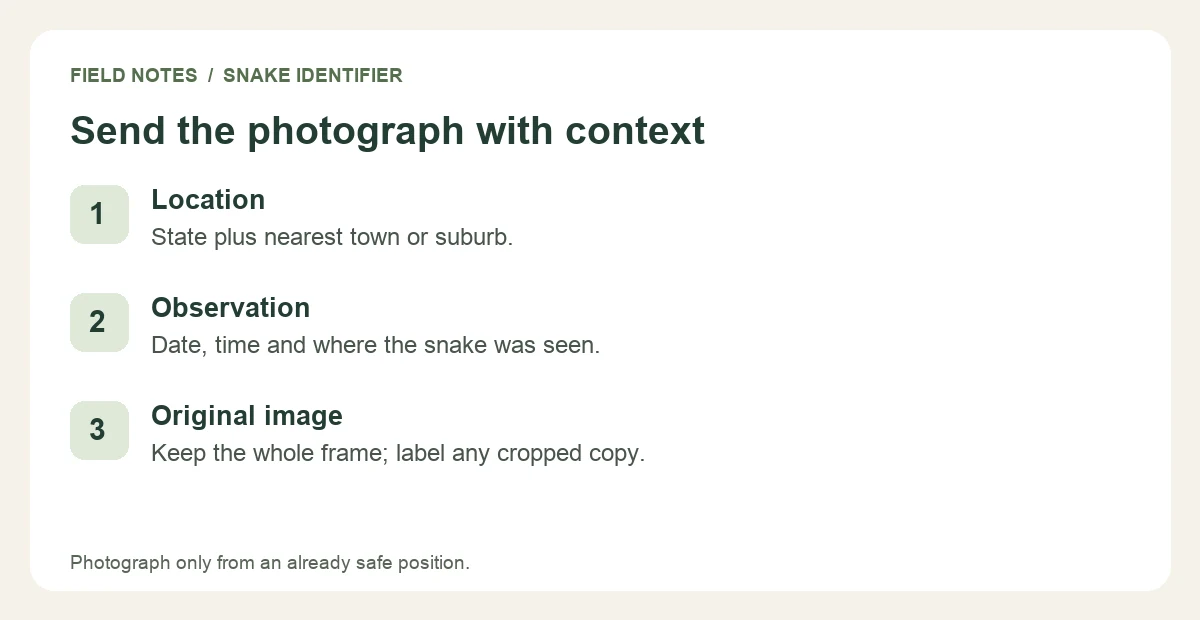
Two similar-looking snakes may have very different ranges. Give a useful locality rather than just “Australia”: a nearby town or suburb is a good starting point. Add whether the snake was beside water, in vegetation, on a path or inside a building.
The Western Australian Museum’s identification instructions ask for location, date and habitat information with specimens and allow digital photographs as an initial enquiry. Check the receiving organisation’s instructions before sending material.
Keep the original, even if you make a crop
A crop can help a reader find a small snake in a large frame. Send the uncropped version as well so the surrounding scene is not lost. Avoid colour filters, heavy sharpening or adding generated detail. An enlarged blur still contains limited evidence.

.jpg)
Use images showing the visible body and pattern if you already have them. Do not return for a close-up of the head or underside. Mark uncertain observations as uncertain: “estimated length” and “belly not visible” are more useful than guesses presented as facts. Our guide to pupil shape and venom explains why eye shape alone cannot establish whether a snake is venomous.
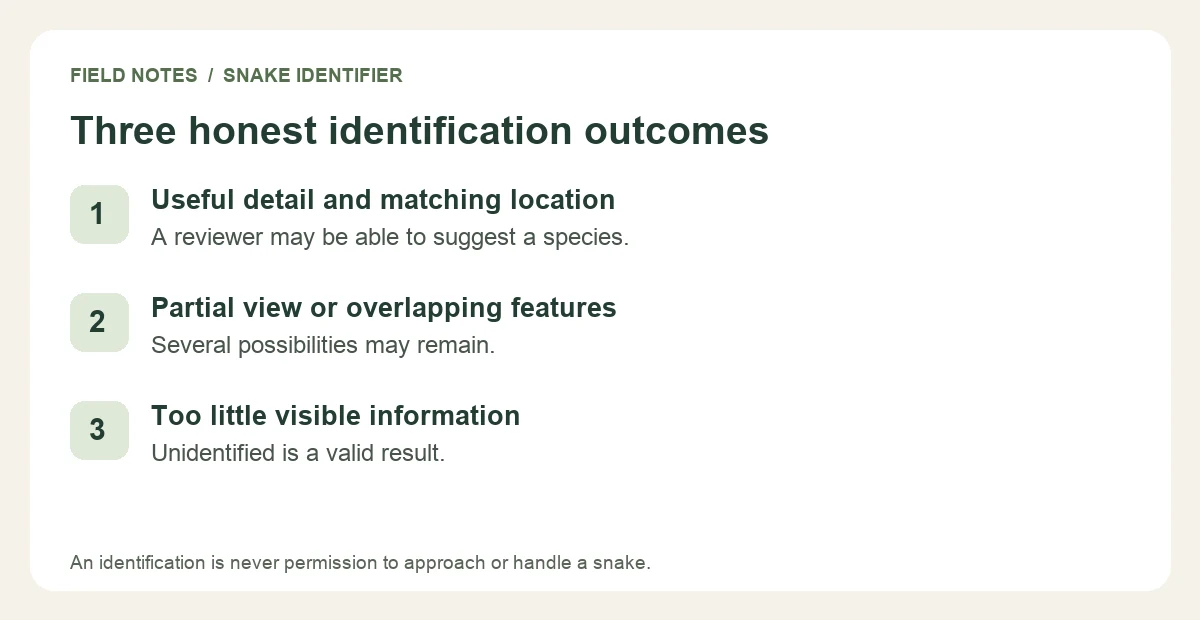
A still image may also leave behaviour uncertain. Our guide to intertwined snakes explains why touching bodies alone do not establish mating.
What a photo tool can and cannot do
Treat a photo tool’s result as a suggestion to compare with species accounts. Read the distribution and variation notes, not only the thumbnail. A confident label does not restore details hidden by grass, blur or the angle of the photograph. The Queensland identification FAQ recommends photographs taken safely and cautions against relying on colour alone.
If a bite may have happened
Call 000 for an ambulance. Do not wait for a website or social-media reply. Use the site’s Australian snakebite first-aid guidance while following the emergency operator’s instructions.
Use the snake identifier to compare your photograph’s visible features with possible matches.
Related: Brown snake lookalikes · Identifying shed snake skin
Sources checked 25 September 2026: Western Australian Museum: identification requests; Queensland Government: snake questions; ANZCOR: Australian snakebite guidance.
If you are unsure whether the animal is a snake, our snake or legless lizard guide explains useful clues and their limits.