
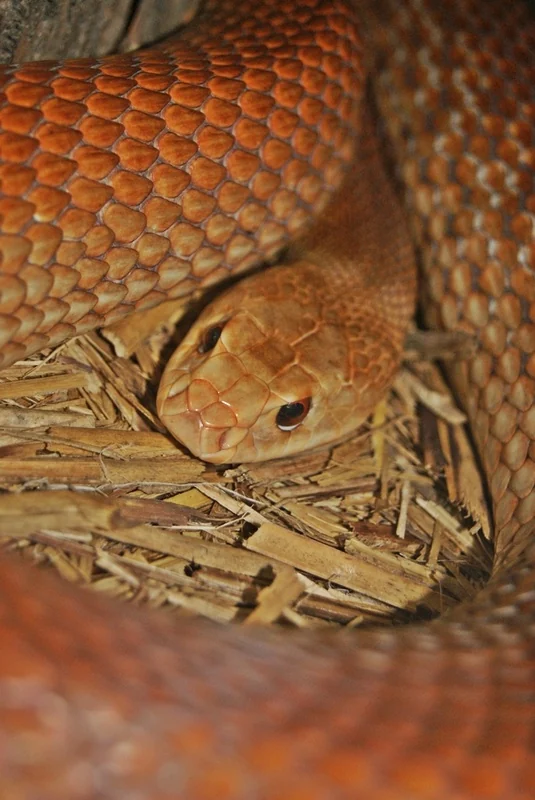
A brown-coloured snake is not necessarily an eastern brown snake, and an eastern brown snake is not always brown. Start with the location, then compare the whole visible animal. Colour alone cannot establish its identity or whether it is safe.

.jpg)
What an eastern brown can look like
The Australian Museum’s eastern brown account describes a slender to moderately built snake with a relatively small head. Colour ranges from pale tan to near black. Young animals may have dark head markings and body bands; some retain bands as adults. A plain, tan reference photograph therefore cannot rule out a darker or banded sighting.
Other snakes can look brown too
The coastal taipan is one important comparison within its range. The museum’s taipan account notes a typically pale snout and a larger head distinct from the narrow neck. These are clues to compare in an existing photograph, not features to approach a snake to inspect.

The mulga snake is also called the king brown snake, but belongs to the black-snake genus Pseudechis. Adults are often robust, with scales that can give a two-toned appearance. The common name is not a reliable guide to which snake group you are looking at. Read the museum’s mulga account.
What about a brown snake with blotches?
Carpet pythons can have brown or olive backgrounds with cream markings. A pattern is useful information, but “patterned” does not by itself mean python. Compare the layout of the markings, the body proportions and the location together.


What to record
Write down the suburb or nearest town, whether the snake was on the ground or climbing, and any markings visible without approaching. Keep the original photo. If all you saw was a brown body disappearing into grass, “unidentified snake” is a useful and honest result. Do not provoke a display, inspect its mouth or turn it over to settle the question.
Use your location and visible clues in the snake identifier to compare possible matches.
Related: Identifying a black snake · Using a snake photograph
Sources checked 25 September 2026: Australian Museum: Eastern Brown Snake; Australian Museum: Coastal Taipan; Australian Museum: Mulga Snake; Queensland Government: carpet python; Queensland Government: snake questions.
Our guide to why young snakes can look different from adults explains two examples of changing colours and markings.