
Elapidae
Ingram’s Brown Snake
Pseudonaja ingrami
A large dangerously venomous brown-snake relative of western Queensland and the Barkly.
Dangerously venomous
Identification and appearance
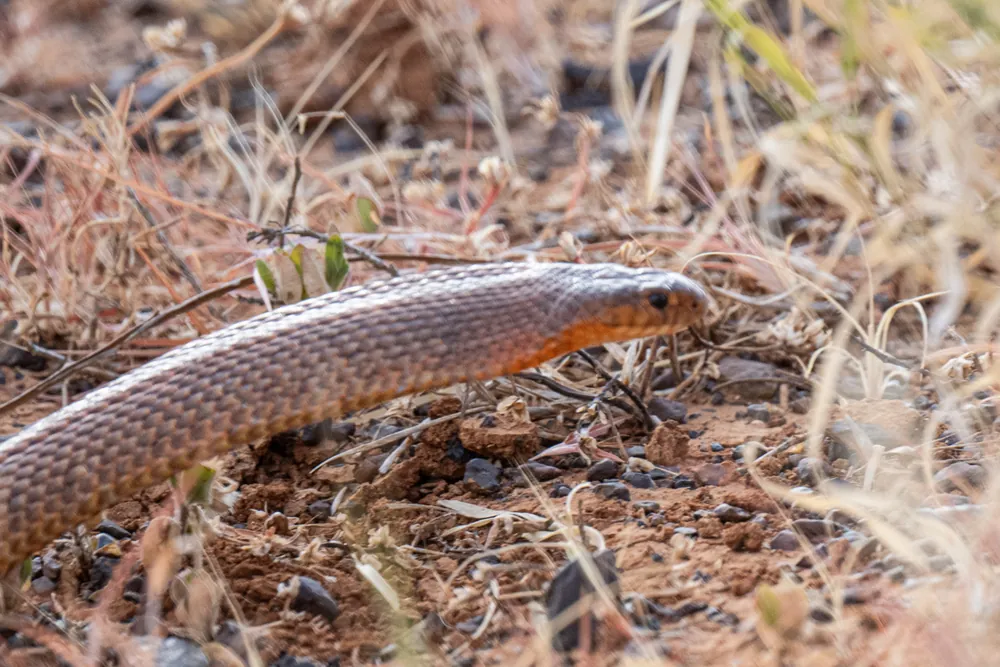
Upperparts vary from light brown to black or reddish brown, usually with fine dark flecks at the scale edges. It occurs on cracking-clay grasslands; the Western Australian record remains uncertain.
Typical length
Queensland Government gives an average length of about 100 cm and an upper length of 150 cm for its regional account. These are not a measured typical adult interval.
Key identification features
- Brown to grey-brown or reddish upperparts, sometimes very dark
- Fine dark flecks along scale edges
- Cracking-clay grassland habitat
Where it is found
Black-soil plains in western Queensland and the Barkly Tableland of the Northern Territory; Kununurra museum material is unconfirmed and is not treated as a verified Western Australian occurrence.
Activity
Usually active by day; may also be active at night in hot conditions.
Diet
Mammals are the principal reported prey.
Reproduction
Egg-laying; AROD reports an average clutch size of 15.
Medical significance
A bite may cause serious envenoming. Treat any suspected bite as an emergency, call 000 and do not wait for identification.
What to do if you encounter one
Keep your distance and leave the snake a clear route away. Do not handle it, chase it for a photograph or attempt to inspect its mouth. If it is inside a building, keep people and pets clear and contact a qualified local snake catcher.
Similar-looking snakes
Ingram's Brown Snakes can resemble Western, Northern and Eastern Brown Snakes. A brown body or darker head is not enough to tell them apart.
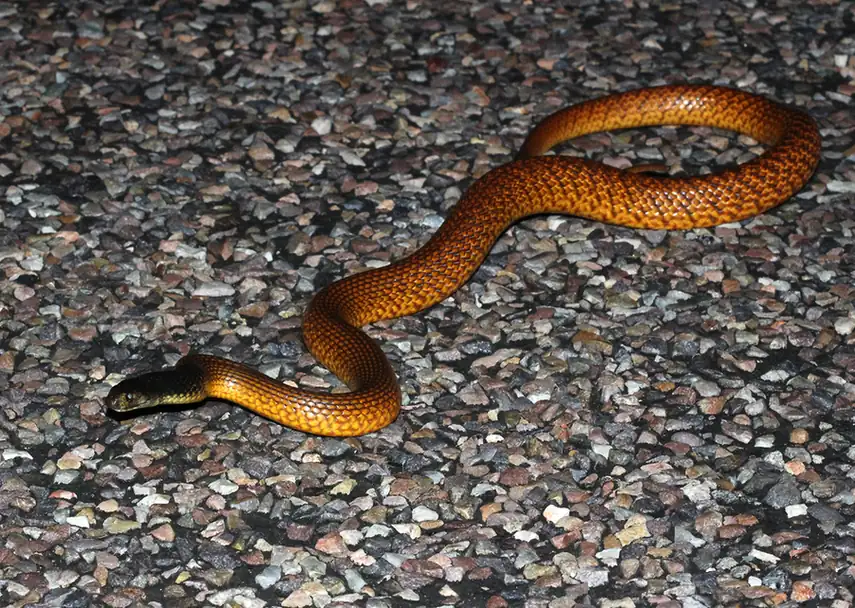
Photo: Lachlan Copeland · CC BY-SA 4.0 (Licence)
Elapidae
Western Brown Snake
Pseudonaja mengdeni
A slender inland brown snake with yellow, orange or brown body forms and variable dark markings.
Open identification guide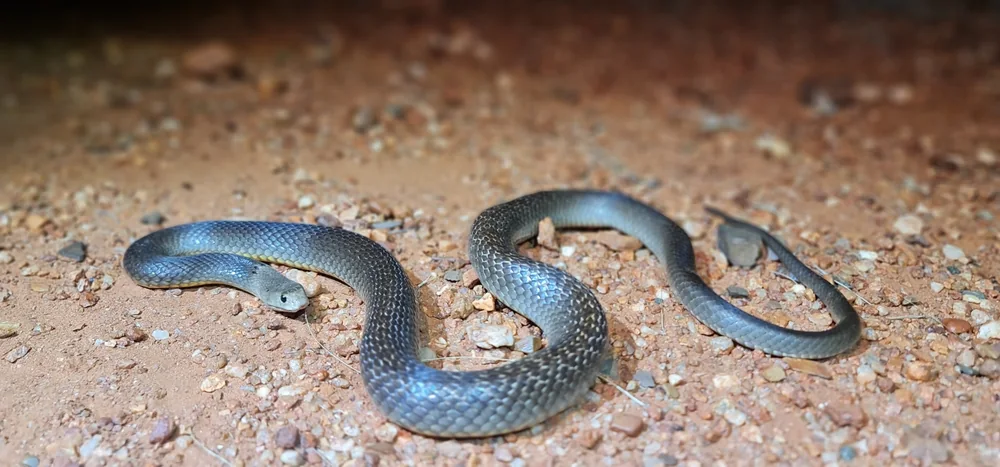
Photo: Max Tibby · CC0 1.0 (Licence)
Elapidae
Northern Brown Snake
Pseudonaja nuchalis
A dangerously venomous brown snake of tropical northern Australia.
Open identification guide
Photo: Donald Hobern from Copenhagen, Denmark · CC BY 2.0 (Licence)
Elapidae
Eastern Brown Snake
Pseudonaja textilis
An Eastern Brown Snake is not always brown. Adults can be tan, orange-brown or nearly black, while young snakes may have striking dark bands. A relatively small head and slender body are more useful clues than the name alone.
Open identification guideTaxonomy notes
Western Australia is retained as a qualified possibility: state lists include it, but AROD questions Kununurra specimens and notes misidentifications.
Sources checked
- Australian Reptile Online Database — Ingram’s Brown Snake (2026-09-25)
- The Reptile Database — Pseudonaja ingrami (2026-09-25)
- ANZCOR — First Aid Management of Australian Snake Bite (2026-09-25)
- Queensland Government — Ingram’s Brown Snake (2026-09-26)
Still not sure?
Compare this snake with more clues.
A profile is a guide, not a reason to approach or handle a snake.