

Elapidae
Olive Sea Snake
Aipysurus laevis
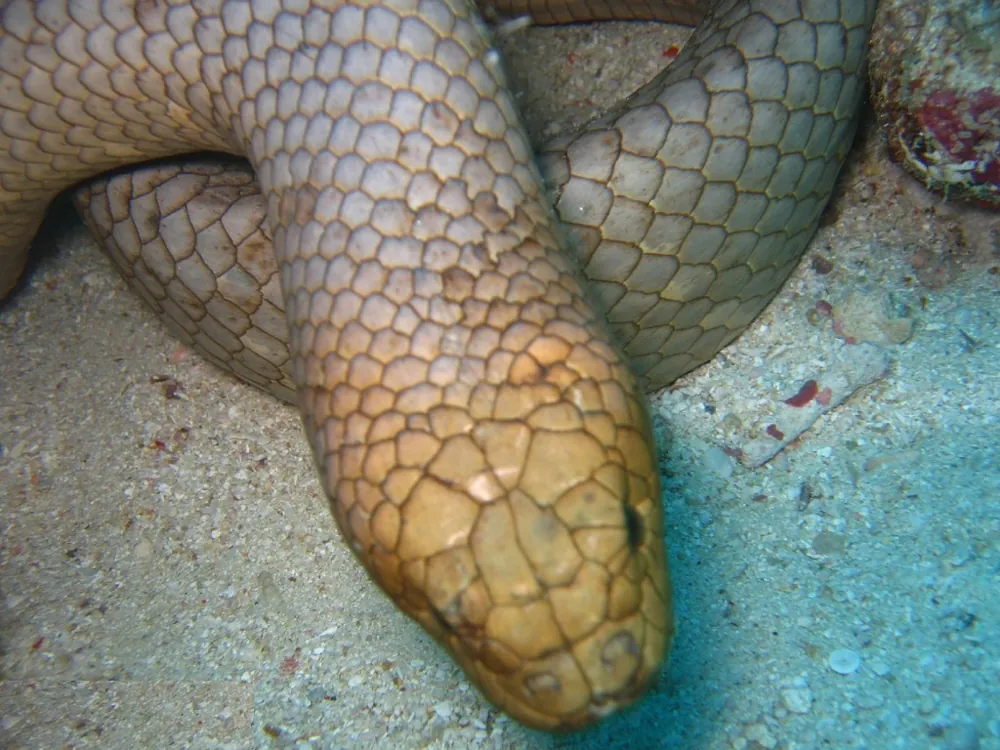
A robust marine snake whose colour changes with age. Adults may be creamy-yellow or golden-brown; younger animals can have pale bands on a dark body.
Highly venomous
Identification and appearance
Adults in the WA Museum account are mainly creamy-yellow or golden-brown, usually with a darker head. Young snakes are darker with narrow pale bands; residual spots may persist as they grow.
Other names
Golden Sea Snake
Typical length
AROD reports an average of 170 cm and a maximum of 200 cm, without establishing a typical adult interval. Smith’s museum series included subadult males to 777 mm and females to 1703 mm.
Body build
robust
Key identification features
- Robust marine snake
- Adults often creamy-yellow or golden-brown
- Pale bands and residual spots can occur in younger snakes
Where it is found
AROD describes a range from the Exmouth area east to the central New South Wales coast and north into the Coral Sea and New Guinea. The current Reptile Database marks NSW with a question mark, so the combined state treatment remains partial.
Habitat
Great Barrier Reef research identifies shallow inshore waters as important habitat for this species. It also uses coral reefs.
Activity
Searches reef crevices for prey by day and night.
Diet
Eats a variety of fish, along with fish eggs and some marine invertebrates, including prawns, squid and moulting crabs.
Reproduction
Live-bearing.
Medical significance
The consulted sources classify this snake as highly or dangerously venomous. Any suspected bite requires immediate emergency medical care.
What to do if you encounter one
Keep away from the animal and do not enter its path. Never handle, net or disentangle a sea snake; alert local marine authorities or a qualified wildlife professional if intervention is necessary.
Similar-looking snakes
Other sea snakes may overlap in marine habitat and body pattern. Never use a photograph or a close approach to decide whether a sea snake is safe.
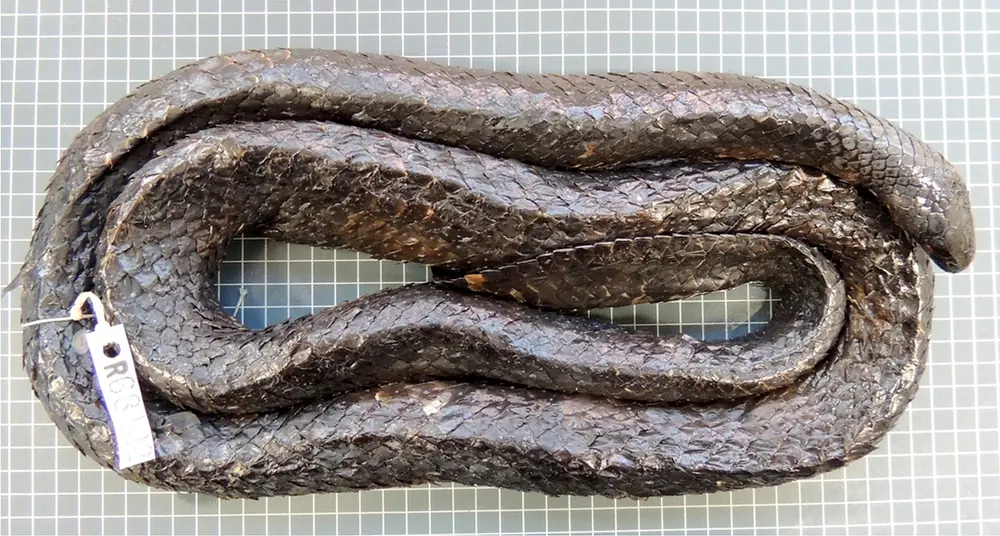
Preserved short-nosed sea snake specimen SAMA R68142 from Ashmore Reef. Preserved colours do not represent a living snake reliably.
Photo: Kate L. Sanders, Tina Schroeder, Michael L. Guinea, and Arne R. Rasmussen · CC BY 4.0 (Licence)
Elapidae
Short-nosed Sea Snake
Aipysurus apraefrontalis
A rare sea snake recorded in north-western Australian waters. Coastal and offshore populations vary in size and colour; an older museum account describes a cream form with bluish-brown bars.
Open identification guideElapidae
Western Turtle-headed Sea Snake
Emydocephalus orarius
A large coastal Western Australian sea snake with 19–21 body bands. The current diagnosis records a maximum total length of 116 cm, with records from Shark Bay through the Pilbara to the Kimberley.
Open identification guideTaxonomy notes
AROD range prose reaches central NSW, while the current Reptile Database lists NSW with a question mark alongside NT, QLD and WA. NSW is retained as an explicitly qualified occurrence, not silently excluded.
Sources checked
- Australian Reptile Online Database — Olive Sea Snake (2026-09-25)
- The Reptile Database — Aipysurus laevis (2026-09-25)
- Smith 1974 — The Sea Snakes of Western Australia (2026-09-26)
- Fauna of Australia — Hydrophiidae (2026-09-26)
- Ineich and Laboute — Sea snakes of New Caledonia (2026-09-26)
- James Cook University — North Queensland sea-snake ecology (2015) (2026-09-26)
Still not sure?
Compare this snake with more clues.
A profile is a guide, not a reason to approach or handle a snake.