

Elapidae
Stephens’ Banded Snake
Hoplocephalus stephensii
A nocturnal snake of forests and rocky country from southern Queensland to the NSW Central Coast.
Venomous
Identification and appearance
Broad dark bands cross a brown or yellow-brown body. The head has a dark background with a brown crown, pale patches near the neck and alternating pale and dark lip markings.
Typical length
NSW Government reports length up to one metre. This is a reported upper size, not a typical adult range.
Key identification features
- Brown or yellow-brown body with broad dark bands
- Dark head with a brown crown and pale neck patches
- Climbs trees and shelters in bark, hollows and rock crevices
Where it is found
Coast and ranges from southern Queensland to Gosford in New South Wales.
Habitat
Rainforest, eucalypt forest and rocky country provide habitat. Daytime cover includes vines, peeling bark, hollows in trees and branches, and gaps or slabs in rock.
Activity
Nocturnal.
Diet
Frogs, lizards, birds and small mammals.
Reproduction
Live-bearing.
Medical significance
For any suspected snakebite, call 000 and follow snakebite first aid. Do not wait for identification.
What to do if you encounter one
Keep well clear and leave a route towards cover. Do not chase, corner, handle or inspect it. If it is inside a building, keep people and pets away and contact a qualified local snake remover.
Similar-looking snakes
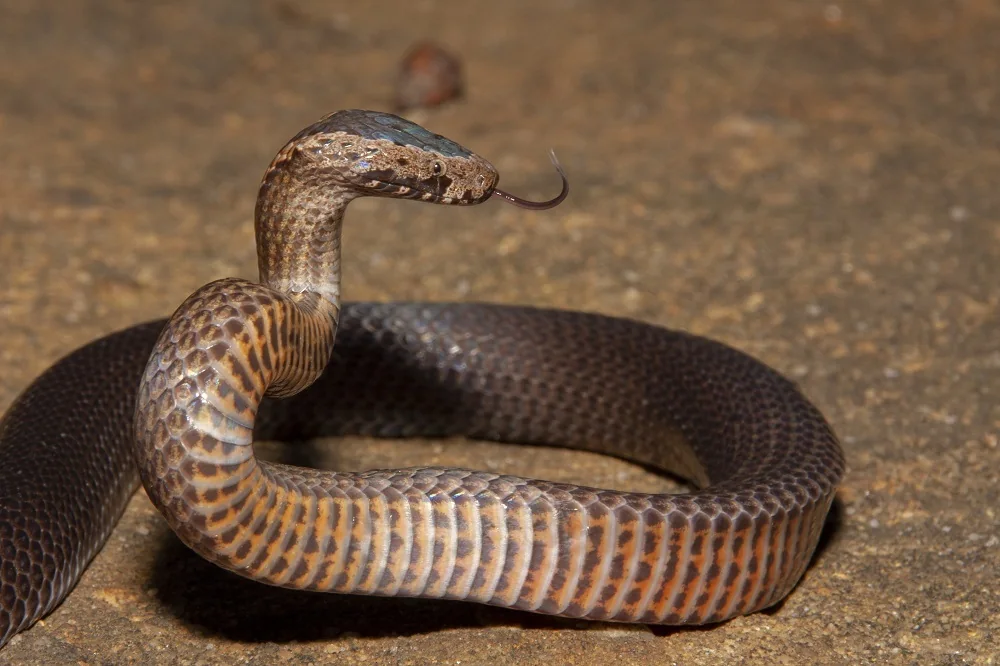
Photo: dhfischer · CC BY 4.0 (Licence)
Elapidae
Golden-crowned Snake
Cacophis squamulosus
A dark snake with a yellowish streak along each side of the neck and onto the head. The checked range runs from the Goulburn region of New South Wales north to Proserpine in Queensland.
Open identification guide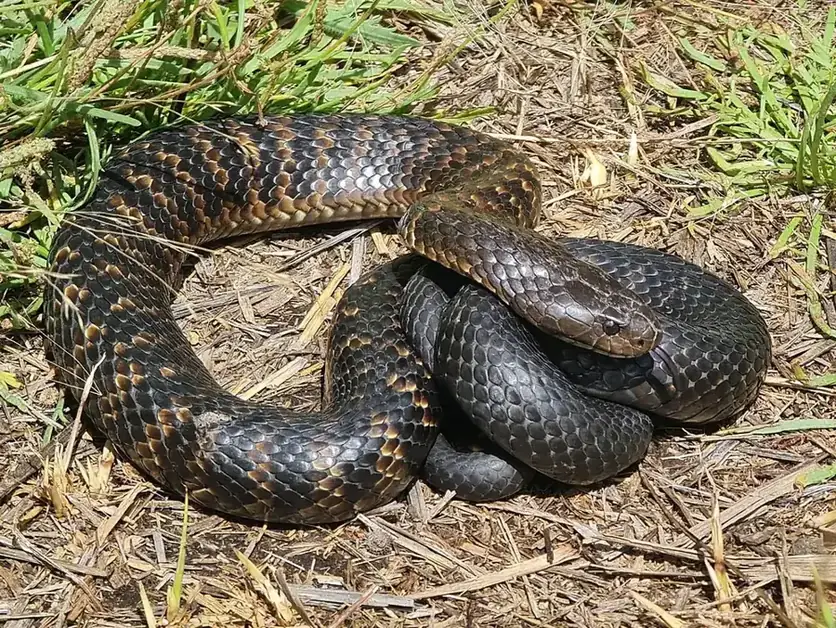
Photo: Max Tibby · CC0 (Licence)
Elapidae
Tiger Snake
Notechis scutatus
Tiger snakes may be banded, faintly marked or completely plain. They are robust snakes associated with many southern wetlands, but also occur in drier habitats. A black snake in Tasmania, or one without stripes, can still be a tiger snake.
Open identification guideSources checked
- Australian Reptile Online Database — Stephens’ Banded Snake (2026-09-25)
- The Reptile Database — Hoplocephalus stephensii (2026-09-25)
- NSW Government — Stephens’ Banded Snake profile (2026-09-26)
Still not sure?
Compare this snake with more clues.
A profile is a guide, not a reason to approach or handle a snake.